Something happens toward the end of the Christian Calendar for those who love to follow Christ's story from Advent to Pentecost. A strange dissolution of momentum, a break in following a story that has been developing from infancy into adulthood, and then at Christ’s ascension into eternal glory. As we move through Holy Week in the month of Advent and move toward Pentecost Sunday later in May, I wanted to invite you into a new spiritual journey. We have been following the story of Christ, but there are stories that created the very things Christ would come to complete and fulfill.
Before the New Testament presented the moving and dramatic story of Christ, the Hebrew Scriptures offered stories for Jesus to consider in his own life. Dramatic redemptive events that foreshadowed that someone greater was coming, and with them a greater salvation. Again and again, the writers and editors of the New Testament slowed down to draw connections to the Hebrew Scripture stories (more often than not, those stories were read in the Greek translation of the Hebrew Scriptures, called the Septuagint). You could say, without the Hebrew Scriptures, Christ’s story would lack a narrative structure. There would be no people he was born into, no dramatic salvation required for those people and their neighbors, and no sense of divine presence that Christ reimagined and fulfilled in the New Testament stories. Jesus not only entered the world “in the fullness of time” (Galatians 4:405), he entered lively sacred stories that we today call the Hebrew Scriptures. Jesus’s life turned a page in that story, giving birth to new storytellers who recounted God’s presence among the people of God in the person and work of Jesus Christ.
Today, we call the Hebrew Scriptures and the Greek New Testament “the Bible.” Even the name is ancient, dating back to the 2nd century BCE. It became a Hellenistic Jewish way of referring to Scripture as “τα βιβλία,” which is translated as “the books.” The word “βιβλία” was derived from a Phoenician city called Byblos, known for exporting papyrus used in the making of scrolls. As we move toward completing the story of Christ on Pentecost Sunday, I want to invite you to explore the stories of “the books” that inspired Christ’s life and ministry.
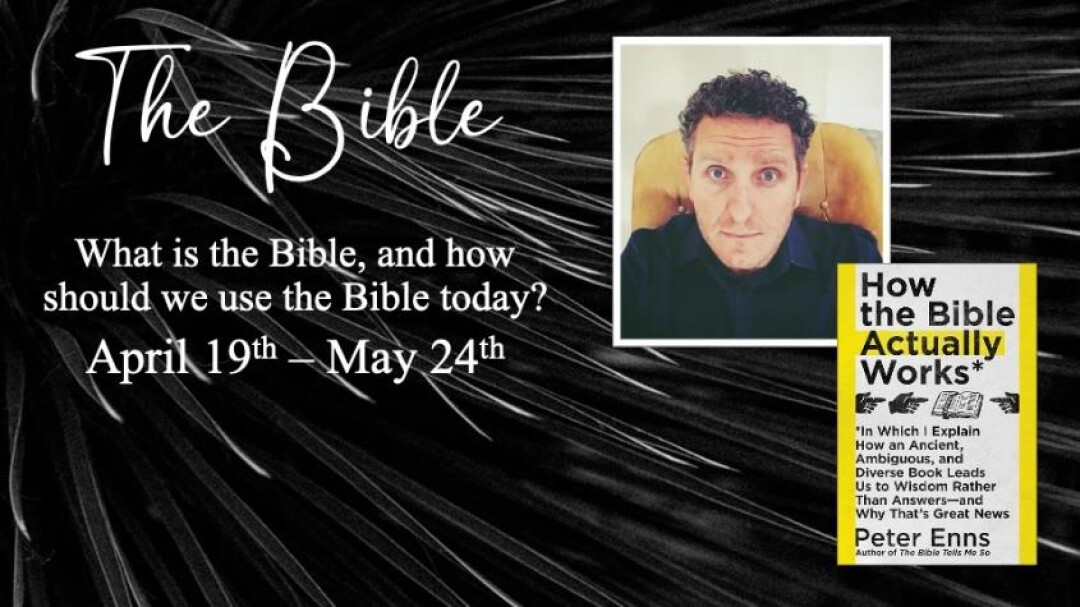
There are two ways you can enter the wondrous world of the ancient collection of writings we call “the Bible.” (1) You can join me in my adult education class on Sundays from April 19th to May 24th. Over six weeks, we will explore the nature of the Bible and close our time by looking at how the Bible’s nature should inform how we read and use the Bible today. My adult education class will be less focused on the stories of the Hebrew Scriptures and more on the literary history of their creation and the transmission of the books over time, as well as the ancient worlds that shaped and informed their content.
If you are unable to attend my class called “The Bible,” there is another way you can enter the strange world of the Bible. (2) You can consider reading the following three books in the order suggested below, moving from the stories of the Hebrew Scriptures, to how they were formed and shared, and finally, to how they were read by the earliest Jewish readers.
Begin with Ellen F. Davis’s wonderful entry-level book called Opening Israel’s Scriptures. Davis takes you book-by-book through the Hebrew Scriptures, introducing you to the stories and messages of each book. Ellen F. Davis is the Amos Ragan Kearns Distinguished Professor of Bible and Practical Theology at Duke Divinity School (https://divinity.duke.edu/faculty/ellen-davis). Among her contributions is her invitation to a deeper appreciation of how early Jewish interpreters understood the biblical stories in the Hebrew Scriptures and how Christian readers received them afresh in light of Christ. She also explores what she calls biblical agrarianism, noting that much of the history of God’s people was spent in agrarian societies that lived very close to the lands they called home.
After you have a good understanding of the larger stories of the Hebrew Scriptures, step back and consider how the Bible’s ancient nature should inform our reading and use it today. Peter Enns’s book How the Bible Works offers you an entry-level exploration of the nature of the Bible. Peter Enns is the Abram S. Clemens Professor of Biblical Studies at Eastern University (https://www.eastern.edu/peter-enns). Among his contributions is his invitation to his readers to consider reading the Bible on its own terms, as an ancient book that behaves like books of its time.
Enns consistently situates the books of the Bible in relation to what is called “parallel literature,” books that share the same literary genre, raise similar questions, and, at times, even include similar characters and events. He also places the books of the Bible in conversation with ancient works that appear to have intentionally interpreted and reflected on the Hebrew Scriptures. When the Bible is read in light of its parallel literature and with a grasp of how it was first interpreted, modern readers read it on its own terms, as a book deeply relevant to the times and cultures of its creation and early transmission.
With the groundwork provided by Davis’s wonderful introduction to the stories and messages of the books of the Hebrew Bible, and Enn’s thoughtful placing of the Bible in its ancient context and early reception history, you will have the ability to appreciate the gift of James L. Kugel’s book The God of the Old: Inside the Lost World of the Bible. Kugel’s book will give you the opportunity to slow down and pay careful attention to the meaning of a few biblical stories and events in light of their ancient context and early Jewish reception history. James L. Kugel is the professor emeritus in the Bible department at Bar Ilan University in Israel and the Harry M. Starr Professor Emeritus of Classical and Modern Hebrew Literature at Harvard University (https://www.jameskugel.com). Among his contributions is the way Kugel shares the early Jewish reception history of stories and characters from the Hebrew Bible with readers at both the academic and popular levels. Kugel is arguably one of the most significant voices in the world today for how the Bible was read by its earliest Jewish interpreters. If you find great value in his book The God of the Old, consider moving on to his much fuller treatment, The Bible as it Was or How to Read the Bible: A Guide to Scripture, Then and Now.
As you move through the Christian Calendar, following the story of Christ from Advent to Pentecost, may you enter a rich season of reflection on the ancient collection of books that inspired and shaped Christ’s life and ministry, the Hebrew Scriptures. You, my friends, are part of this wondrous, ancient story; you are the pages being written today!
Pastor Tony